Showing posts with label classic movies. Show all posts

Sunday, January 25, 2015

Peeping Tom (1960)

 
   On the special features of the DVD for this film, there is a documentary entitled "A Very British Psycho," and there is almost no better way to sum up this film than by saying just that. Peeping Tom was the last big film made by renowned and celebrated English director Michael Powell, who was most famous for visually stunning classics like Black Narcissus, The Red Shoes, and The Thief of Bagdad. All those films by Powell mentioned plus several others are featured as a part of the prestigious Criterion Collection, including Peeping Tom. Peeping Tom is one of the best psychological character studies in film, not just horror films, but all film. The title character is an antisocial photographer who struggles with his voyeuristic urges and ends up killing several models of the course of the film, but does so while filming them. This film was very shocking when it was first released and it definitely had the potential to turn into a Henry: Portrait of a Serial Killer-esque film, in that it could have shown us a merciless sociopathic unfeeling killer. Instead of doing that however Peeping Tom is wonderfully sympathetic of its main character, making the audience feel for him and whatever psychological illness he struggles with. The film also differs from most serial-killer films because the main character does seek out treatment and does seem to progress at points throughout the film, even though (trying not to give any spoilers here) the film does end with a rather tragic tone. The film is very Freudian showing how childhood traumas can cause behaviors or disorders that can last the rest of the child's lifetime. Other notable things about the movie are one: that the cinematography is gorgeous and there are a lot of unique and interesting POV shots, two: the acting is fantastic, and three: Powell cast himself as the main characters cold scientific seemingly inhuman father who photographed the main character's every move when he was a child. A role that Powell actually slightly resembled in real life through the fact that he always carried a camera with him and filmed everything, and that he cast his own son to play the main character as a child. The film received terrible reviews initially and 
its theatrical run in the UK only lasted 2 weeks. Later that year Hitchcock released his similar film Psycho (which of course has become an immortal classic) and he surprised the press by telling them he wouldn't have a special pre-release screening for the film (a film industry standard that is still practiced today even). When asked why he wouldn't have the screening Hitchcock had this to say: "You saw what happened to Mickey's film (referring to Powell), therefore I'm serious when I say there will be no press screening. They may hate my film even more!" Peeping Tom essentially ruined Powell's career for the remainder of his life until shortly before his death the film earned praise by "New-Hollywood" directors like Martin Scorsese and Francis Ford Coppola. The film has regained the praise it missed initially, throughout the years becoming a cult classic as well as universally loved by critics, regarded as both a classic and an art film, and by many one of the greatest films of all time. Though the film can be tense at times (even though no graphic violence is ever shown on camera) it is worth watching all the way through, and I give it a 5/5. Instead of posting the trailer like I normally do, I've decided to include the film's opening scene below. The movie is also featured in Rue Morgue's 200 Alternative Horror Films You Need to See

Thursday, March 27, 2014

The Walking Dead (1936)

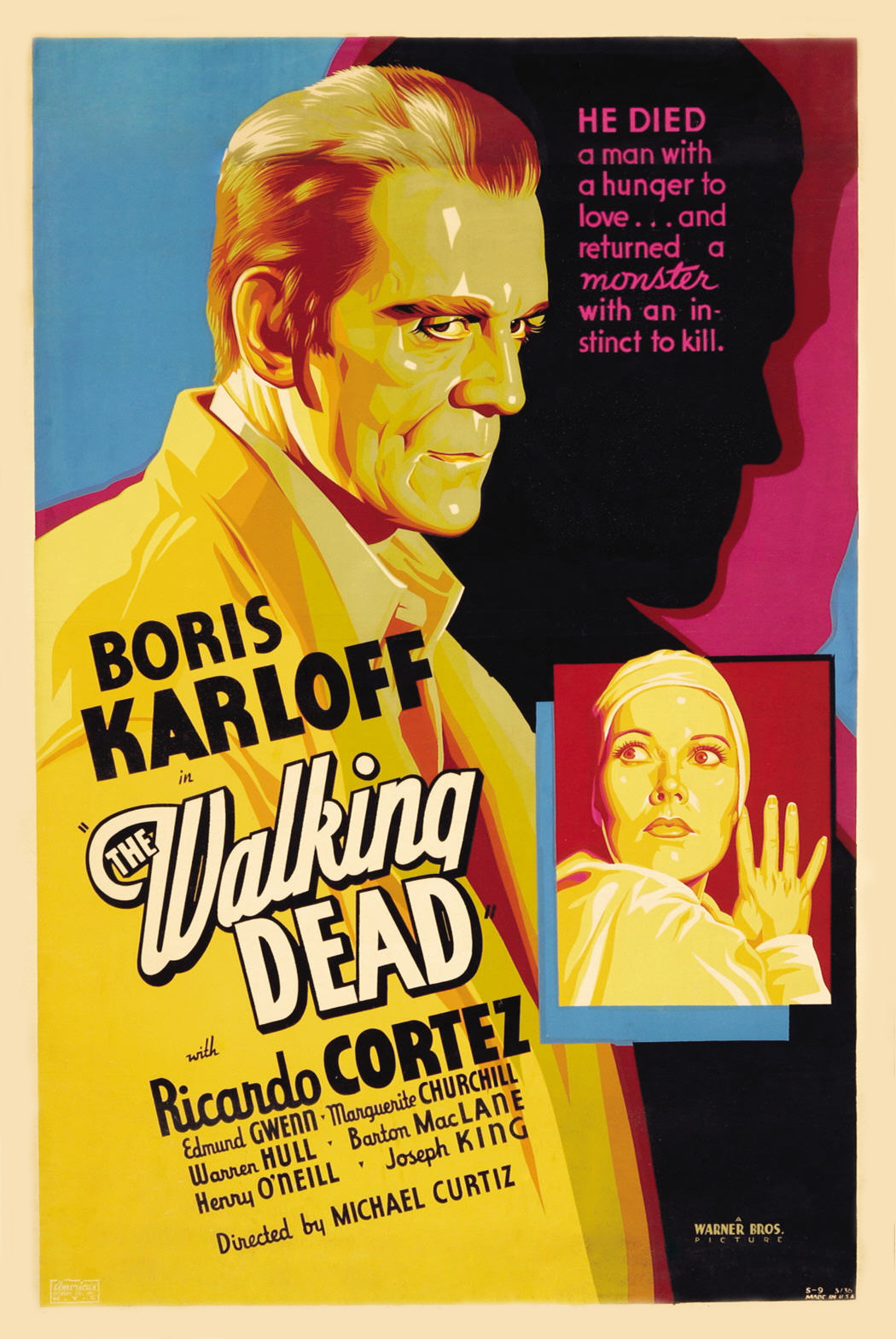
The 1930s are known for such immortal horror classics as Frankenstein (1931), Dracula (1931), King Kong (1933) and The Invisible Man (1933). But often forgotten are other great horror films that should be just as widely known as the aforementioned, like The Most Dangerous Game (1932), The Island of Lost Souls (1932), and this gem. Though White Zombie (1932) is credited as the first zombie movie, it like many early "zombie" movies only used the term zombie in the context of people being hypnotized or drugged during voodoo rituals,  (people who are either just hypnotized and called "zombies" or people who were under the influence of a drug that made them appear dead and then came back to life, but were never dead at any time) but I would argue that this could be considered the first zombie film in a sense as well. This (from what research I did) is the first time the term "the walking dead" is used, it is also one of the first times a person comes back from the dead and is not the same as they were, (Dracula and Frankenstein excluded). Boris Karloff was very influential on the overall turnout of the film. For example his character was originally supposed to not speak once revived, and was supposed to have "Tarzan-like agility," and Karloff thought the
character's lack of speech was too similar to his Frankenstein role, and that the character
should walk more slowly as his body probably would have sustained injury from receiving such large amounts of voltage. It was also Karloff's idea to make his character more likable and also empathetic by having him be a musician instead of a bum and an alcoholic. It is mentioned on IMDB's "Connections" section for the film that "The movement of the first zombie in Night of the Living Dead (1968) was inspired by the way John Ellman walked." This film also has unique cinematography for its time, and a unique blend of on location sets and fabricated ones. The plot of the story is that Karloff plays a man who is framed and sentenced to the electric chair, two witnesses to the crime come to his aid to clear his name, but they arrive too late, however an experimental medical procedure is done involving implanting a mechanical heart The procedure is a success, but when he comes back he is not the same, into Karloff's body to bring him back to life. he now knows subconsciously who framed him, but he is not able to voice any information that he has gained about life after death upon his return from the other side. Karloff's character is wonderfully empathetic, you really feel for him as Karloff has such a wonderful expressive face. The film also has a wonderfully creepy atmosphere since Karloff's character frequents walking through 
graveyards. The ending is also very good in that it has a message/warning  similar to that of Frankenstein and other "coming back from the dead" stories like The Monkey's Paw, in that it is better to let the dead stay dead, and also that one should not "play God." I really enjoyed the film and I give it a 5/5. I could not find a trailer for this film.

Wednesday, March 26, 2014

Compulsion (1959)

This film is based on the Leopold and Loeb murder trial that happened in the 1920s and was considered by many to be the "trial of the century" when it occurred. Leopold and Loeb were two college aged young adult males who prided themselves on their "superior" intellects, so they sought ought to prove their intellect to others by committing the perfect crime, they murdered a 14 year old boy to prove they could get away with it. Obviously the crime was not made without mistakes, otherwise the two never would have been caught, but they were due to one of the men leaving behind his glasses at the scene of the crime. The two were represented by arguably the most famous defense lawyer of all time Clarence Darrow (the same attorney appointed to the defense at the legendary Scopes Monkey trial, that occurred one year after the Leopold and Loeb case). Darrow gave a 12 hour speech pleading directly to the judge (when pleading guilty to a charge, a jury can be thrown out and the defense can aim their argument  solely at the judge) which is thought by many to be the best of his career. The film did a very good job of being accurate when describing the details of the actual crime and the trial. The only thing that may not have been the most accurate in the film was the portrayal of the relationship between Leopold and Loeb, in real life their relationship was also an intimate one, and due to film codes in the 1950s that detail of the case was spared. I am also unsure how much of the speech made by Darrow was word for word accurate in the film, but I do know that it is one of the best speeches I have
ever heard in general, and by far probably the best speech/argument I've ever heard against the death penalty.
 The legendary actor/director Orson Welles played Darrow in the film and gave a phenomenal performance, even if he only was in the film for less than a half hour (out of the films two hour total length). The rest of the acting was all very good as well, Dean Stockwell gave  one of the more notable performances of his career. This was the first critically acclaimed fact-based crime drama directed by Richard Fleischer, Fleischer would go on to direct at least two other critically acclaimed crime dramas based on true stories with The Boston Strangler (1968) and 10 Rillington Place (1971), as well as several famous sci-fi films (Soylent Green[1973] and The Fantastic Voyage[1966]). There are several other films based on the Leopold and Loeb murder case, the most famous being Alfred Hitchcock's Rope (1948) with Jimmy Stewart, and French director Michael Haneke's Funny Games (1997), but Compulsion is the most historically accurate portrayal. The film did drag a little bit at times though, and the trial only took up the last half hour or so of the film, so with those being my only beefs with the film I give it a 4.5/5 and I recommend it to anyone who likes classic films, or crime dramas. You can view the trailer below:

Saturday, March 22, 2014

Village of the Damned (1960)

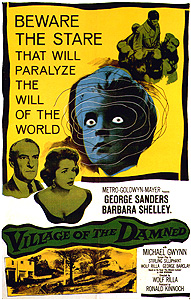
Although universally thought of as a classic, today it is often overlooked and forgotten about in favor of other classic 60s horror flicks like Night Of The Living Dead (1968) or other classic Sci-Fis like Invasion of The Body Snatchers(1956), but this film should still be just as talked about and beloved as it once was for it holds up remarkably well almost 55 years later. Imagine The Omen (1976) except instead of one evil kid running around destroying things with his mind, you get 12 of them in this movie. The children are born when (after a mysterious sleeping spell overtakes a whole town) all the women in a town become pregnant. Oscar winning actor George Sanders (who is known for his cold calculative and often slimy characters, to which this film's no exception) does a wonderful job as the scientist who wants to keep the children alive for the sake of studying even after they begin to commit unspeakable crimes. The special effects done to the children's eyes are still spooky even by today's standards. The film also builds marvelously until the very end (some older films can really lag, but this is well paced for the time it was made). The film does have at least one sequel (Children of The Damned, which is also acclaimed, and Iron Maiden did a saong of the same name about that film) and the honor of being remade 35 years later by horror legend John Carpenter, but from what I have read there seems to be no doubt that the original is the best. I give it a 5/5, and you can view the trailer below:

Tuesday, March 18, 2014

All About Eve (1950)

This might be the film I've reviewed that I've most strongly connected/personally related
to. All About Eve is the six Oscar winning (including best picture) 1950 film that is as timeless as any classic. The film tells/shows the destructive power of  ambition/planning (albeit to others whose ambitions overlap) deception and jealousy, and of course the power of the theater which encapsulates all three of those. The film is incredibly relevant even to those outside of the theater though because of the competitive and "fake" nature life sometimes seems to take on due to the insincerity of others (which oddly enough is just as damaging be it detectable or undetectable). The film ultimately is a reminder of the old Shakespeare adage: "All the world is a stage, and we but actors on it," and lastly the film serves as a powerful reminder to me of the importance and value I hold for sincerity; From myself and from others. Bette Davis plays an aging theater actress, Margo Channing. One night Margo gets a visit from a fan whose admiration of her is so impressive to Margo and her entourage, that Margo decides to employ the fan as her full time secretary. Eventually it becomes known to all though that the stories the secretary 
(Eve) tells are all fiction though and that Eve had her rise to stardom through the friendship of Margo and her entourage planned from the beginning, and Eve's
humility is nothing more than a testament to her ability to act. Eve is one of those people I'm sure we all either have or will encounter at some point, who doesn't care who they hurt while they try to get what they want (and simultaneously ingratiating themselves into the hearts of others, due to their lack of realizing the individual's ulterior motives), this film also serves as a reminder that at one point or another in our lives we ourselves be similar (though maybe to a lesser extent) to the title character (it's more or less in the nature of being ambitious, one just needs to really try to find a balance and hopefully ultimately be more sincere). This film also has an abundance of great quotes, wit, and of course acting. Though neither lead actress won the Oscar for this film George Sanders did win Best Supporting Actor for his marvelous part in the film. The film has a 100% rating on RottenTomatoes.com, it is listed in several of my cult movie books, and is agreed upon almost universally as one of the greatest movies ever made. The film is a little long, but in my opinion it never really felt sluggish, and it actually had pretty good pacing and is worth almost every moment. As I mentioned before the film has many famous quotes that have since become even more well known than the film they're from, the best example of this is when Davis's character says: "Fasten your seatbelts, It's going to be a bumpy night!" I give it a 5/5, and you can find the film available to stream on Netflix.  I don't really like trailers for older films, but you can view it below nonetheless: 

Thursday, March 6, 2014

John Carpenter's The Thing (1982)


I finally saw John Carpenter's version of The Thing. I was a big fan of the 50s original The Thing From Another World (1951), plus I'm not a big fan of gore and I knew this movie was very bloody and I saw some of the special effects when I was younger, and got freaked out, so that made me hesitant to watch this for a while. But I really enjoyed this version. The story of course is about a team of scientists working in Antarctica when some Norwegians and a stray dog, the one living Norwegian is killed by the scientists who mistakenly think he was shooting at them when he was actually shooting at the dog. The scientists then
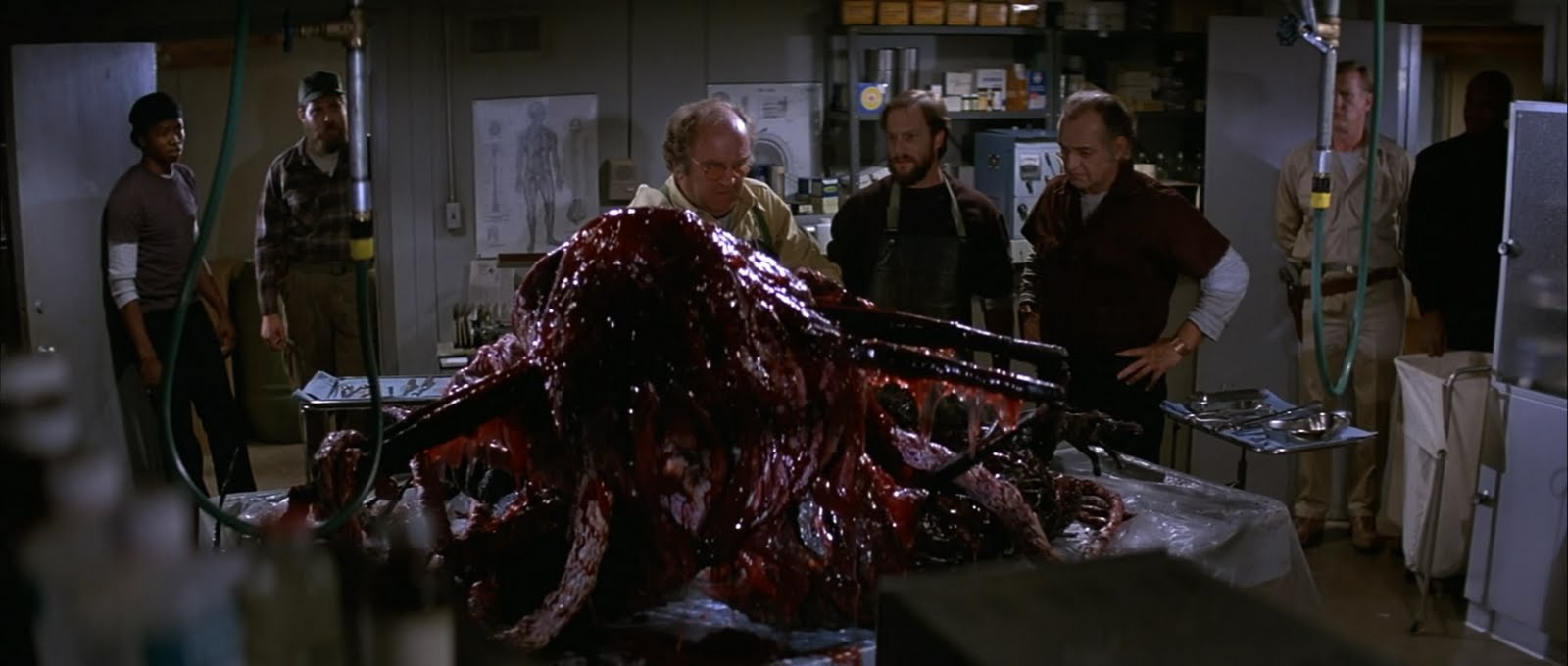
 take the dog into their camp and all the trouble begins when they discover "the dog" is actually a shape-shifting alien that can take over anyone's identity, also taking over  their body while doing so. This film has marvelous pacing and only a handful of scenes with the alien so as to create maximum suspense and scares. The film also has a marvelous cast with Kurt Russell as the lead, and Wilford Brimley ( the "diabeetus," guy) Keith David and several other great character actors as well. This movie is known for having some of the greatest special effects of all time, and  more than 30 years after its release I'd say they are still impressive and very unique. The 80s were the perfect time for The Thing to be remade, for one thing they now had much more impressive effects to make the monster scary and show it more often, and also the story's use as an allegory for fear of communism and the Russians was extremely fitting for the 80s as well. The original Thing From Another World has been argued by many to be an allegory for McCarthyism, and when you think about it, it  makes sense; Senator McCarthy was accusing everyone of being communist  even if they just knew people who were communist, they were assumed to
be communist also, just like in The Thing when people are assumed to be the Thing if they were in contact with that person, and citizens were asked to keep an eye on their friends and neighbors just like the characters in both versions of The Thing were. Also the 1980s was when the U.S.'s fear of/rivalry with Russia was at its peak, so the 1980s was a very apt time for a remake of The Thing, the film even ends with an ending that is symbolically a  prediction/warning about communism similar to Dr. Seuss' Butter Battle Book (1984) (I don't want to give away the ending however so if you are unfamiliar with that story you can look it up). All in all I was very impressed with The Thing and I give it a 5/5, You can view the trailer below:

Sunday, February 16, 2014

The Hour of The Wolf (1968)


If you ask any film buff who Ingmar Bergman is/was, they would most likely tell you he's one of the greatest directors of all time, if you were to ask me who he is, I'd say one of my favorite directors. Bergman is known for his art house films, and such ground breaking pictures such as The Seventh Seal (1957). It is not a rare or strange occurrence for a Bergman film to be dark in nature, or to have dark over/undertones, (the Seventh Seal is about a Knight playing chess with Death) but Hour of the Wolf is Bergman's only official horror movie. Like a lot of Bergman's films, this one can be confusing at times, but I believe if you pay enough
attention to the beginning and end of the story, then you should have a good enough understanding of the film. The story is about an artist (Max von Sydow) who struggles with inner demons, which appear to be physically manifesting themselves and affecting his wife just as badly as they do himself. Now when I say demons in this context, I'm referring to the artist's inner mental struggles and guilt. There is a phrase that is bookended in the film (told at the beginning and the end) that best sums up this film's plot: "Do you think it is possible that if a woman loves a man enough for such a long time, that eventually she becomes like that man?" This film has some of the trippiest imagery Bergman ever used, and you almost feel that you're going crazy along with the main character. It is of course left to interpretation however if what happens to the character is actually happening to him or not, (that gives it a similar feel to The Innocents [1961]) but that of course was intentional. The movie has several allusions to classic horror movies/literature/concepts, one of them being an actor who looks exactly like Bela Lugosi, and another being the presence of Poe's raven. I really liked this one, the only thing that bothered me was that the plot was sometimes hard to follow, but as I mentioned before, the ending in my opinion more or less justifies that. I give it a 4.75/5, view the trailer below:

Wednesday, January 29, 2014

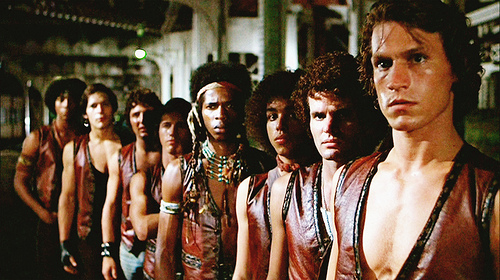
The Warriors (1979)

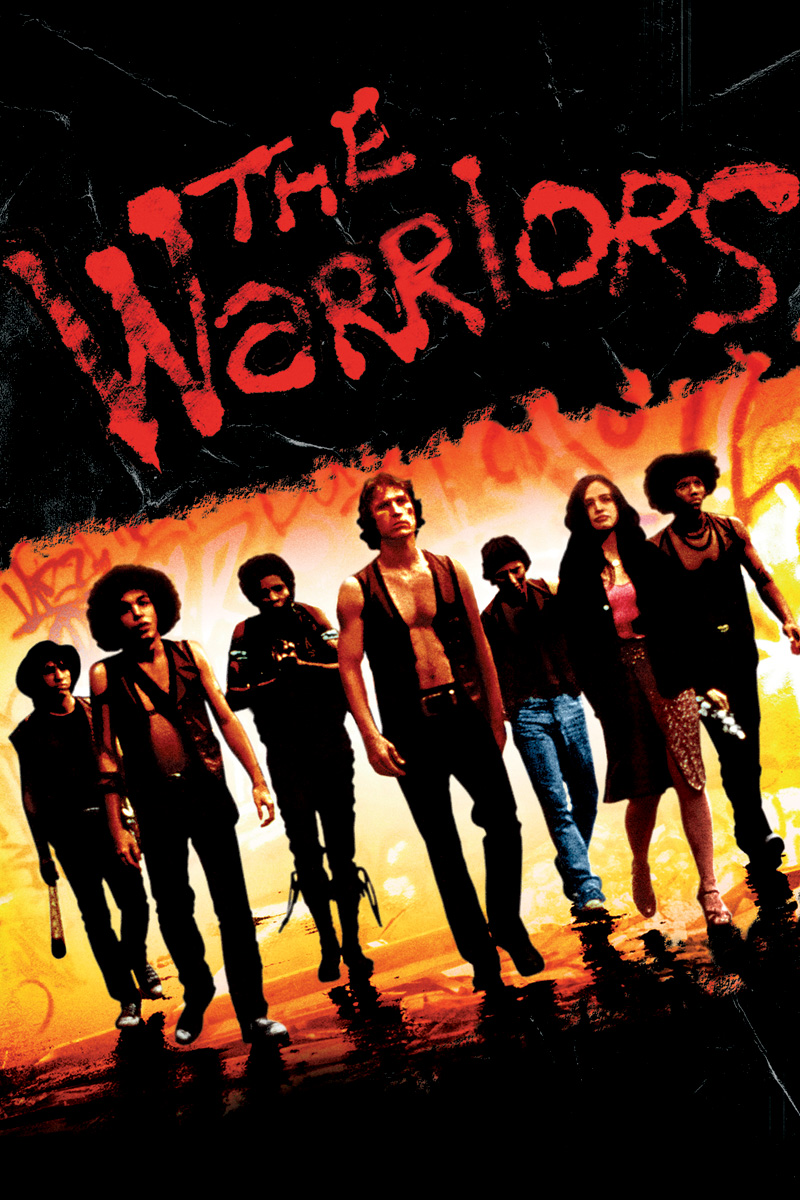
If you were to look up an example of what a "cult" movie is I think you would first run into the Star Wars franchise, then perhaps the Evil Dead series and then The Warriors would probably be listed next. This film has maintained a strong cult following since its release 35 years ago. When I was in high school/middle school (junior high) this film had a resurgence of popularity because it had two popular video game adaptations made of it one in 2005 just called The Warriors, and one in 2009 called The Warriors:Street Brawl, and there have also been comic book adaptations of the film. The film gathered $3.5 million on its opening weekend, but was linked to acts of vandalism and violence the following weekend including 3 killings, two in southern California and one in Boston, involving movie goers heading to or from the theater. Almost all the film's advertising was severely cut to show only the title the rating of the film and theater locations, and at least 200 theaters upped security during showings of the film. Most people nowadays are not aware that the film was actually relatively successful on it's initial release ($16.4 million in its 6th week when the film was made for between $6-7 million) because of its status as a "cult" film. 
The film is about a meeting between all the gangs of New York in the late 70s coming together to hear the leader of the most feared gang in the city propose a citywide truce among all the gangs so that they can work together to better control the city, but one of the people in the crowd didn't like that idea and didn't follow the rules because he came armed, you know this because he shoots and kills the leader Cyrus during his speech. The killer then blames a rival gang called the warriors and everybody is now convinced the warriors are responsible for the killing. The rest of the film is about the warriors trying to get back across the city to their home turf of Coney Island without getting killed by every other gang in the city. This film is definitely partially about youthful angst, but it is also somewhat of an urban retelling of Homer's The Odyssey. The warriors encounter no end of trials on their way back home, from rival gangs to siren like temptations,
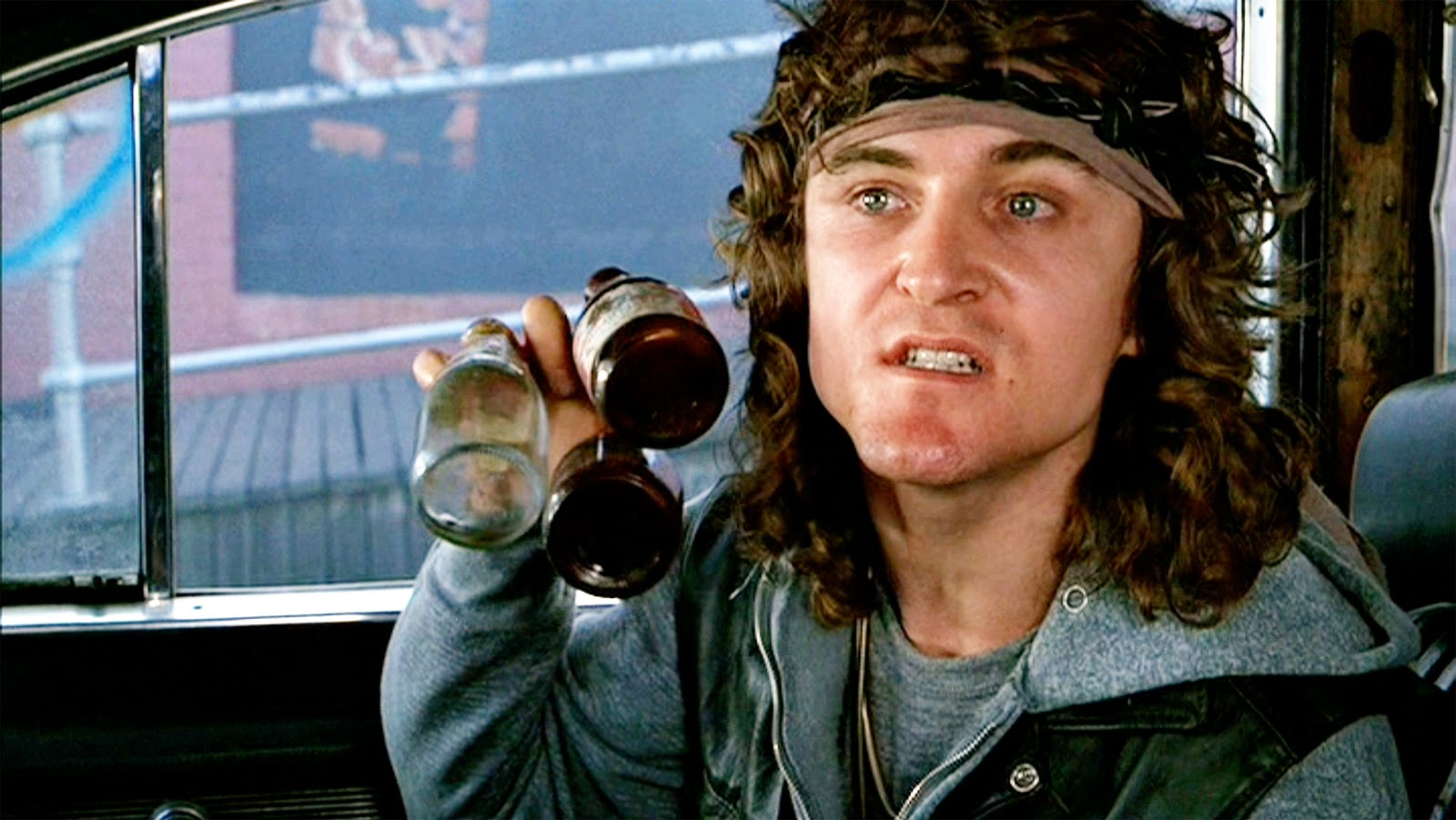
  the police, to being separated from each other. Now I thought I'd never be interested in this film because I've never been the type of person to like the ideas of gangs or gang related violence, but this film is a lot more than that as I just previously mentioned. In addition to the deeper side of the film it is very well done visually and is very visually appealing. Critic Pauline Kael of The New Yorker called it "visual rock". It also has somewhat of a cartoony feel to it because every gang has a different theme, there's a gang of mimes, a gang of ninjas, and a gang of face painted Jersey wearing baseball bat wielding psychopathic ballplayers no less. The director wanted to divide the film into chapters and start each section with a comic book stylized splash panel, but the studio was on a fixed schedule and limited budget so the film never fully achieved its comic book look (though you can still kind of feel it in the opening titles). The most famous scene from the movie of course is the real murderer taunting the warriors with the now famous,then improvised, cry of:  "Warriorrrrrrrrrrs, come out to plaaaaaaaaaaaaay!" 
Though visually top notch this film does seem a bit empty (like more could have been happening at times) in certain scenes, and the acting is pretty good all around but you don't really get to see too much character development throughout, and some of the acting is just plain cheesy, but in the best possible way (in the last ten minutes especially). This movie is also noted as an early appearance of future Oscar winning actress Mercedes Ruehl, and this movie features the 70s hit single "In the City" by Joe Walsh (the song was from this movie). I give this a 4.25/5 overall, a 4 for how well made it is, and a 4.5 for how much I enjoyed it, so that averages to about 4.25/5. You can view the trailer below:  

Saturday, January 18, 2014

Badlands (1973)

Terence Malick has only directed six movies in the last 40 years, and Badlands (1973) was his first film. The film is based on a real life murder spree committed by the young couple of Charles Starkweather and Caril Ann Fugate while travelling across the US in the 1950s. All of Terence Malick's films are critically acclaimed with very little to no negative reviews and I won't break the chain. Martin Sheen (father of Charlie Sheen and Emilio Estevez) and Sissy Spacek (the Original Carrie) are great in their respective roles: Sheen as a mentally delusional trigger happy emotionless anton Shugar (No Country For Old Men)-like character, who is simultaneously a James Dean lookalike/wannabe and mixed up youth, and Spacek as the mixed up naive 15 year old Sheen takes along on his ride. The film is beautiful visually, shot in the Badlands of South Dakota, and in telling it's story: the murders and murderers are not glorified, rather we see how delusional sheen's character is and the rise and fall of his relationship with Spacek as she realizes how crazy he really is. Think Bonnie & Clyde with Bonnie being a whole lot less involved. The film is now part of the Criterion Collection. I give it a 5/5. You can view the trailer below I recommend stopping around 2:02 though, because the rest of the trailer is pretty revealing of the rest of the movie: 

Monday, January 13, 2014

The Gorilla ( 1939)

 The Gorilla (1939) is an "old dark house" horror/comedy  starring the legendary Bela Lugosi (original Dracula[1931]) and The Ritz Brothers (a poor man's version of The Marx Brothers). Ever since Edgar Alan Poe wrote the first detective mystery with Murders in the Rue Morgue, Gorillas have had their place in horror from King Kong (1933) to Disney cartoons with Donald Duck. This film attempts to channel the thrills of silent horror murder mystery films like 
The Cat and the Canary(1927) (recreating its most famous scene) 
and fuse it with the aforementioned fear of gorillas. The film takes place in a millionaire's mansion (full of secret passages) during a storm of course.
This came out the same year as the Bob Hope sound
 remake of The Cat and the Canary (1939). The gorilla isn't as good as the bob hope film, but this is still a classic even though the costumes might be hokey and some of the jokes fall flat it is still fun and well put together. 
 I give it a 4/5. I first heard about this film from this book to the right:
and the film is available through Turner Classic Movies (TCM) with xfinity OnDemand or to stream at tcm.com/watch.