Thursday, March 27, 2014

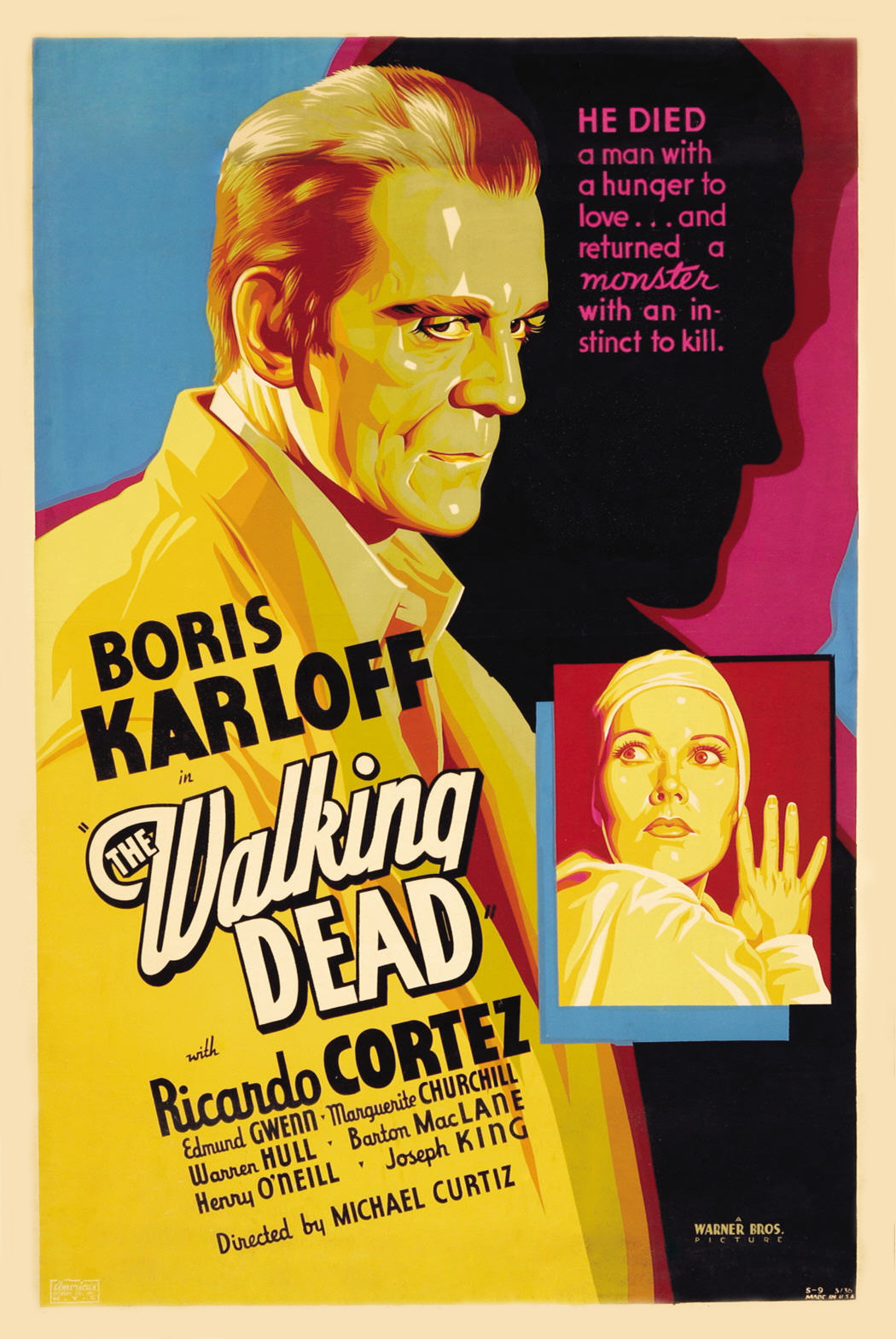
The Walking Dead (1936)

The 1930s are known for such immortal horror classics as Frankenstein (1931), Dracula (1931), King Kong (1933) and The Invisible Man (1933). But often forgotten are other great horror films that should be just as widely known as the aforementioned, like The Most Dangerous Game (1932), The Island of Lost Souls (1932), and this gem. Though White Zombie (1932) is credited as the first zombie movie, it like many early "zombie" movies only used the term zombie in the context of people being hypnotized or drugged during voodoo rituals,  (people who are either just hypnotized and called "zombies" or people who were under the influence of a drug that made them appear dead and then came back to life, but were never dead at any time) but I would argue that this could be considered the first zombie film in a sense as well. This (from what research I did) is the first time the term "the walking dead" is used, it is also one of the first times a person comes back from the dead and is not the same as they were, (Dracula and Frankenstein excluded). Boris Karloff was very influential on the overall turnout of the film. For example his character was originally supposed to not speak once revived, and was supposed to have "Tarzan-like agility," and Karloff thought the
character's lack of speech was too similar to his Frankenstein role, and that the character
should walk more slowly as his body probably would have sustained injury from receiving such large amounts of voltage. It was also Karloff's idea to make his character more likable and also empathetic by having him be a musician instead of a bum and an alcoholic. It is mentioned on IMDB's "Connections" section for the film that "The movement of the first zombie in Night of the Living Dead (1968) was inspired by the way John Ellman walked." This film also has unique cinematography for its time, and a unique blend of on location sets and fabricated ones. The plot of the story is that Karloff plays a man who is framed and sentenced to the electric chair, two witnesses to the crime come to his aid to clear his name, but they arrive too late, however an experimental medical procedure is done involving implanting a mechanical heart The procedure is a success, but when he comes back he is not the same, into Karloff's body to bring him back to life. he now knows subconsciously who framed him, but he is not able to voice any information that he has gained about life after death upon his return from the other side. Karloff's character is wonderfully empathetic, you really feel for him as Karloff has such a wonderful expressive face. The film also has a wonderfully creepy atmosphere since Karloff's character frequents walking through 
graveyards. The ending is also very good in that it has a message/warning  similar to that of Frankenstein and other "coming back from the dead" stories like The Monkey's Paw, in that it is better to let the dead stay dead, and also that one should not "play God." I really enjoyed the film and I give it a 5/5. I could not find a trailer for this film.

Wednesday, March 26, 2014

Compulsion (1959)

This film is based on the Leopold and Loeb murder trial that happened in the 1920s and was considered by many to be the "trial of the century" when it occurred. Leopold and Loeb were two college aged young adult males who prided themselves on their "superior" intellects, so they sought ought to prove their intellect to others by committing the perfect crime, they murdered a 14 year old boy to prove they could get away with it. Obviously the crime was not made without mistakes, otherwise the two never would have been caught, but they were due to one of the men leaving behind his glasses at the scene of the crime. The two were represented by arguably the most famous defense lawyer of all time Clarence Darrow (the same attorney appointed to the defense at the legendary Scopes Monkey trial, that occurred one year after the Leopold and Loeb case). Darrow gave a 12 hour speech pleading directly to the judge (when pleading guilty to a charge, a jury can be thrown out and the defense can aim their argument  solely at the judge) which is thought by many to be the best of his career. The film did a very good job of being accurate when describing the details of the actual crime and the trial. The only thing that may not have been the most accurate in the film was the portrayal of the relationship between Leopold and Loeb, in real life their relationship was also an intimate one, and due to film codes in the 1950s that detail of the case was spared. I am also unsure how much of the speech made by Darrow was word for word accurate in the film, but I do know that it is one of the best speeches I have
ever heard in general, and by far probably the best speech/argument I've ever heard against the death penalty.
 The legendary actor/director Orson Welles played Darrow in the film and gave a phenomenal performance, even if he only was in the film for less than a half hour (out of the films two hour total length). The rest of the acting was all very good as well, Dean Stockwell gave  one of the more notable performances of his career. This was the first critically acclaimed fact-based crime drama directed by Richard Fleischer, Fleischer would go on to direct at least two other critically acclaimed crime dramas based on true stories with The Boston Strangler (1968) and 10 Rillington Place (1971), as well as several famous sci-fi films (Soylent Green[1973] and The Fantastic Voyage[1966]). There are several other films based on the Leopold and Loeb murder case, the most famous being Alfred Hitchcock's Rope (1948) with Jimmy Stewart, and French director Michael Haneke's Funny Games (1997), but Compulsion is the most historically accurate portrayal. The film did drag a little bit at times though, and the trial only took up the last half hour or so of the film, so with those being my only beefs with the film I give it a 4.5/5 and I recommend it to anyone who likes classic films, or crime dramas. You can view the trailer below:

Tuesday, March 25, 2014

28 Days Later (2002)

I'd been meaning to see this one for a long time, but just never got around to it like so many other movies on my "to see" list.I had heard basically nothing but good things about this one, though my main hesitation to see it was because I'm not a fan of zombie movies, and yet that's why I liked this one, because it stops being a zombie movie at some point. I had always heard that 28 Days Later was a very non traditional zombie movie, but I was thinking that meant because it was the first film to feature running zombies (lots of movies have used them since though) and other unique qualities that would still make the zombies the key focal point of the movie, while this is true for a while, the film does change at a certain point. At a certain point about a third of the way through the movie, the two main characters meet up with a man and his daughter and flee to the countryside in his taxi cab. Once they leave London, the movie becomes more of an experimental/art film than a zombie film, and zombies won't even be seen again in the film until very close to the end. The
cinematography, countryside and music are all gorgeous at this point in the movie, and the characters are all relieved to be safe and among friends, so their happiness rubs off on the viewer and makes the film just that much more enjoyable. And with the exception of some of the earliest scenes of the movie, even when the zombies are around, the movie is much more about survival and figuring out how to continue/rebuild civilization as we know it than it is about just killing/escaping from zombies. In case you do not know the story, the film is about a zombie apocalypse in London brought on by bacteria found in monkeys. The story really begins though when a man (Cillian Murphy) wakes up from a coma to a completely deserted hospital. The man finds other survivors in the city and the film follows his adventures from there on. The director Danny Boyle is known for using a guerrilla film style with all of his movies ( In Slumdog Millionaire he used cell phone cameras in the alleys of India, Trainspotting uses very fast shaky shots throughout, etc.) and this one 
is no exception. Arguably the most impressive part of this film are its scenes where Murphy walks through a completely deserted London, and that's all real. In order to get the shots of a deserted London, Boyle and his crew filmed early in the morning when there was hardly anyone around and then they used handheld cameras to quickly capture the shots they needed before cars and people would begin to invade their shots. I liked the film and its unwillingness to be confined to the traditions of one specific genre. The ending didn't really sit all that well with me though (it didn't feel like there was any resolution much at all), and I'm still not a big fan of post apocalyptic zombie movies of any kind so I give it a 4.25/5. You can view the trailer below:

Sunday, March 23, 2014

Night of the Comet (1984)

Predating most of the 80s classic teen comedies (John Hughes films included) was this unique film. The film is about people in the L.A. area of California who are all getting ready to watch the arrival of comet fly overhead one night, but then due to unforeseen forces (radiation or possibly some alien bacteria) all who were exposed to the comet were either immediately vaporized, or turned into zombies (those who were in a house as opposed to watching the comet outside). At first it seems only two teenage valley girls (both sisters) survived unharmed (all those who were behind steel structures remained unaffected) and all of L.A. is now their playground. The film is unique not only in its plot but also with its characters and their interactions with each other. The girls' father is in the Military Special Ops forces, and apparently he did weapon and combat training with each of them from a
very young age, so though they are typical 80s teenagers in many ways, they are different because they know their weapons and prefer Uzies, also the older sister is really into/good at video games, and nerdy things like Superman. The film is advertised as a comedy but I didn't find it that funny at all actually, (except for my favorite line of the movie: "I'm not crazy! I just don't give a fuck!") but it was still fun and enjoyable because of how unique and different it is. The movie has a very fitting 80s soundtrack and the highlight of the film (or at least most famous scene) is when the girls go on a shopping spree at an abandoned mall. As interesting as the movie was it never really built to a proper climax in my opinion and it just kind of ended without any kind of (or at least very little) resolution. I still liked it though and recommend it if you dig 80s movies, zombie movies, post-apocalyptic movies, horror comedies, or teen movies in general. The movie is now available on Instant Streaming on Netflix, or you can also find the full movie in decent quality on YouTube here. I give it a 4.25/5, and you can view the trailer below:

Saturday, March 22, 2014

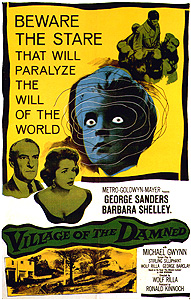
Village of the Damned (1960)

Although universally thought of as a classic, today it is often overlooked and forgotten about in favor of other classic 60s horror flicks like Night Of The Living Dead (1968) or other classic Sci-Fis like Invasion of The Body Snatchers(1956), but this film should still be just as talked about and beloved as it once was for it holds up remarkably well almost 55 years later. Imagine The Omen (1976) except instead of one evil kid running around destroying things with his mind, you get 12 of them in this movie. The children are born when (after a mysterious sleeping spell overtakes a whole town) all the women in a town become pregnant. Oscar winning actor George Sanders (who is known for his cold calculative and often slimy characters, to which this film's no exception) does a wonderful job as the scientist who wants to keep the children alive for the sake of studying even after they begin to commit unspeakable crimes. The special effects done to the children's eyes are still spooky even by today's standards. The film also builds marvelously until the very end (some older films can really lag, but this is well paced for the time it was made). The film does have at least one sequel (Children of The Damned, which is also acclaimed, and Iron Maiden did a saong of the same name about that film) and the honor of being remade 35 years later by horror legend John Carpenter, but from what I have read there seems to be no doubt that the original is the best. I give it a 5/5, and you can view the trailer below:

Tuesday, March 18, 2014

All About Eve (1950)

This might be the film I've reviewed that I've most strongly connected/personally related
to. All About Eve is the six Oscar winning (including best picture) 1950 film that is as timeless as any classic. The film tells/shows the destructive power of  ambition/planning (albeit to others whose ambitions overlap) deception and jealousy, and of course the power of the theater which encapsulates all three of those. The film is incredibly relevant even to those outside of the theater though because of the competitive and "fake" nature life sometimes seems to take on due to the insincerity of others (which oddly enough is just as damaging be it detectable or undetectable). The film ultimately is a reminder of the old Shakespeare adage: "All the world is a stage, and we but actors on it," and lastly the film serves as a powerful reminder to me of the importance and value I hold for sincerity; From myself and from others. Bette Davis plays an aging theater actress, Margo Channing. One night Margo gets a visit from a fan whose admiration of her is so impressive to Margo and her entourage, that Margo decides to employ the fan as her full time secretary. Eventually it becomes known to all though that the stories the secretary 
(Eve) tells are all fiction though and that Eve had her rise to stardom through the friendship of Margo and her entourage planned from the beginning, and Eve's
humility is nothing more than a testament to her ability to act. Eve is one of those people I'm sure we all either have or will encounter at some point, who doesn't care who they hurt while they try to get what they want (and simultaneously ingratiating themselves into the hearts of others, due to their lack of realizing the individual's ulterior motives), this film also serves as a reminder that at one point or another in our lives we ourselves be similar (though maybe to a lesser extent) to the title character (it's more or less in the nature of being ambitious, one just needs to really try to find a balance and hopefully ultimately be more sincere). This film also has an abundance of great quotes, wit, and of course acting. Though neither lead actress won the Oscar for this film George Sanders did win Best Supporting Actor for his marvelous part in the film. The film has a 100% rating on RottenTomatoes.com, it is listed in several of my cult movie books, and is agreed upon almost universally as one of the greatest movies ever made. The film is a little long, but in my opinion it never really felt sluggish, and it actually had pretty good pacing and is worth almost every moment. As I mentioned before the film has many famous quotes that have since become even more well known than the film they're from, the best example of this is when Davis's character says: "Fasten your seatbelts, It's going to be a bumpy night!" I give it a 5/5, and you can find the film available to stream on Netflix.  I don't really like trailers for older films, but you can view it below nonetheless: 

Tuesday, March 11, 2014

Tourist Trap (1979)

This is a very obscure cult classic, but unlike many obscure classics that are good and have seemingly no reason to be (no famous or noteworthy names attached to the project) Tourist Trap has people that add to its unique eccentric style. Most notably Robert A. Burns, the art director from the original Texas Chainsaw Massacre, was involved with Tourist Trap designing the creepiest mannequins I have ever seen, and being responsible for the also very effective special effects that made them come alive. Composer Pino Donaggio, most remembered for his scores for several Brian De Palma films, Carrie (1976) Dressed to Kill 
(1980), Blowout (1981), as well as Jo Dante's Piranha (1978) and Howling (1981) and Nicolas Roeg's Don't Look Now (1973), did a very bizarre carnival-esque score for the film. The plot of the film centers around these college aged kids going on a road trip who decide to stop at a tourist trap along the way; Slausen's Wax Museum. Unfortunately for the kids this is a real tourist trap, and the museum's owner and his crazy "brother" are turning the tourists into mannequins. It is also worth mentioning that the lead character/killer is played by the former star of the 50s TV series The Rifleman: Chuck Conners. As mentioned  before the film has several unique quirks about it (the score, the lifelike mannequins, main actor cast against type) and my favorite is the fact that the killer also has telekinetic powers, forget the 
predictable plot twist, now that's truly
unexpected. Like many great horror flicks from the 70s and 80s this was not a success on its initial release, but it found an audience when it was aired on cable TV in the 80s, garnering none other than Stephen King as one of its many fans. King praises it in his Danse Macabre book as an obscure classic saying that the film "“wields an eerie spooky power, as wax figures begin to move and come to life in a ruined, out-of-the-way tourist resort.” The film was recently released on Blu-ray so it is now more accessible than its ever been. It is truly a unique take on the slasher film, considering it has no blood (there is a little actually, but basically none) or nudity in it and is rated PG, but just like Texas Chainsaw, it feels a whole lot more graphic than it is. The film is featured on Rue Morgue Magazine's 200 Alternative Horror Films You Need to see  list/book. I give it a 4.5/5, you can view the trailer below: