Showing posts with label classic films. Show all posts

Thursday, March 27, 2014

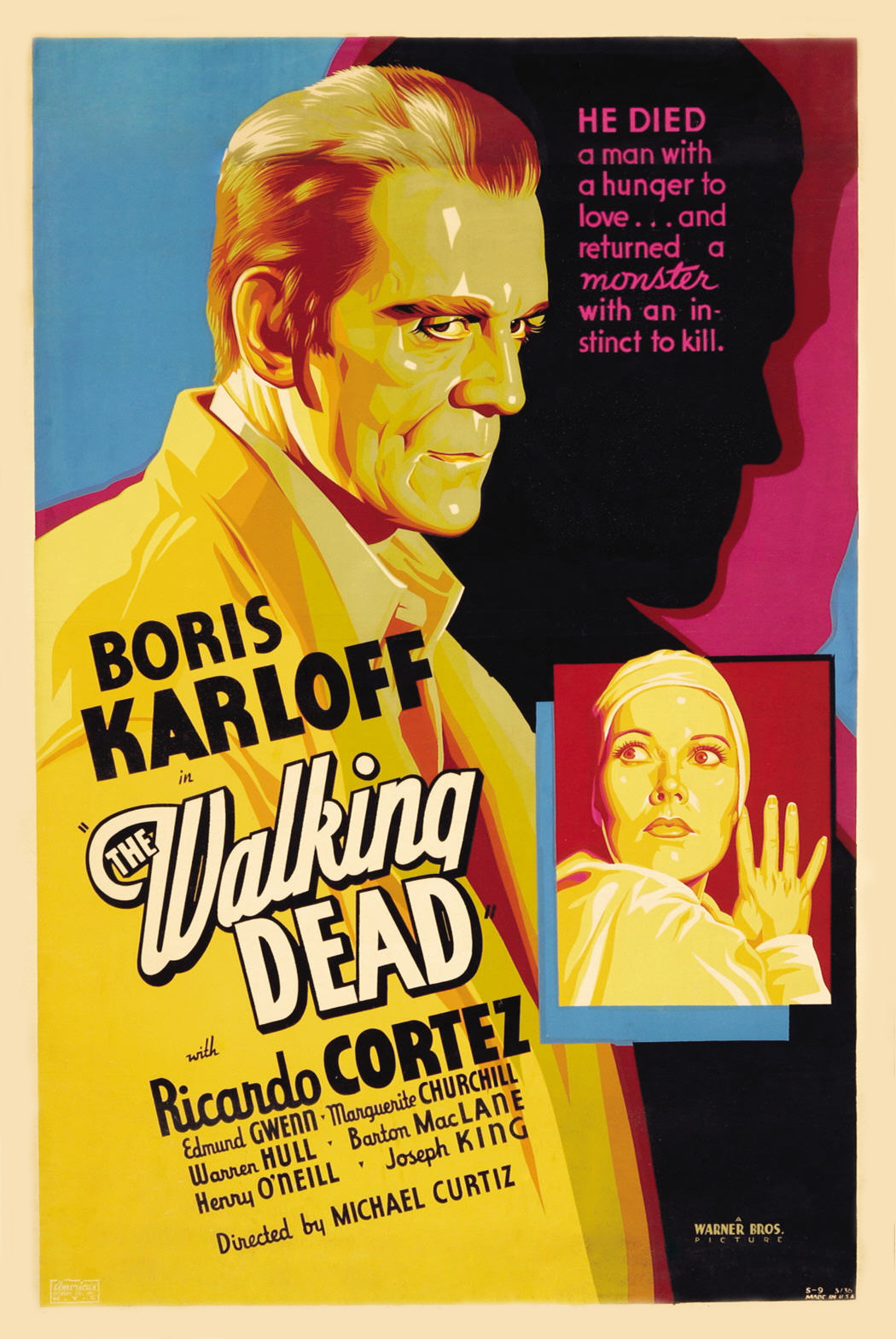
The Walking Dead (1936)

The 1930s are known for such immortal horror classics as Frankenstein (1931), Dracula (1931), King Kong (1933) and The Invisible Man (1933). But often forgotten are other great horror films that should be just as widely known as the aforementioned, like The Most Dangerous Game (1932), The Island of Lost Souls (1932), and this gem. Though White Zombie (1932) is credited as the first zombie movie, it like many early "zombie" movies only used the term zombie in the context of people being hypnotized or drugged during voodoo rituals,  (people who are either just hypnotized and called "zombies" or people who were under the influence of a drug that made them appear dead and then came back to life, but were never dead at any time) but I would argue that this could be considered the first zombie film in a sense as well. This (from what research I did) is the first time the term "the walking dead" is used, it is also one of the first times a person comes back from the dead and is not the same as they were, (Dracula and Frankenstein excluded). Boris Karloff was very influential on the overall turnout of the film. For example his character was originally supposed to not speak once revived, and was supposed to have "Tarzan-like agility," and Karloff thought the
character's lack of speech was too similar to his Frankenstein role, and that the character
should walk more slowly as his body probably would have sustained injury from receiving such large amounts of voltage. It was also Karloff's idea to make his character more likable and also empathetic by having him be a musician instead of a bum and an alcoholic. It is mentioned on IMDB's "Connections" section for the film that "The movement of the first zombie in Night of the Living Dead (1968) was inspired by the way John Ellman walked." This film also has unique cinematography for its time, and a unique blend of on location sets and fabricated ones. The plot of the story is that Karloff plays a man who is framed and sentenced to the electric chair, two witnesses to the crime come to his aid to clear his name, but they arrive too late, however an experimental medical procedure is done involving implanting a mechanical heart The procedure is a success, but when he comes back he is not the same, into Karloff's body to bring him back to life. he now knows subconsciously who framed him, but he is not able to voice any information that he has gained about life after death upon his return from the other side. Karloff's character is wonderfully empathetic, you really feel for him as Karloff has such a wonderful expressive face. The film also has a wonderfully creepy atmosphere since Karloff's character frequents walking through 
graveyards. The ending is also very good in that it has a message/warning  similar to that of Frankenstein and other "coming back from the dead" stories like The Monkey's Paw, in that it is better to let the dead stay dead, and also that one should not "play God." I really enjoyed the film and I give it a 5/5. I could not find a trailer for this film.

Wednesday, March 26, 2014

Compulsion (1959)

This film is based on the Leopold and Loeb murder trial that happened in the 1920s and was considered by many to be the "trial of the century" when it occurred. Leopold and Loeb were two college aged young adult males who prided themselves on their "superior" intellects, so they sought ought to prove their intellect to others by committing the perfect crime, they murdered a 14 year old boy to prove they could get away with it. Obviously the crime was not made without mistakes, otherwise the two never would have been caught, but they were due to one of the men leaving behind his glasses at the scene of the crime. The two were represented by arguably the most famous defense lawyer of all time Clarence Darrow (the same attorney appointed to the defense at the legendary Scopes Monkey trial, that occurred one year after the Leopold and Loeb case). Darrow gave a 12 hour speech pleading directly to the judge (when pleading guilty to a charge, a jury can be thrown out and the defense can aim their argument  solely at the judge) which is thought by many to be the best of his career. The film did a very good job of being accurate when describing the details of the actual crime and the trial. The only thing that may not have been the most accurate in the film was the portrayal of the relationship between Leopold and Loeb, in real life their relationship was also an intimate one, and due to film codes in the 1950s that detail of the case was spared. I am also unsure how much of the speech made by Darrow was word for word accurate in the film, but I do know that it is one of the best speeches I have
ever heard in general, and by far probably the best speech/argument I've ever heard against the death penalty.
 The legendary actor/director Orson Welles played Darrow in the film and gave a phenomenal performance, even if he only was in the film for less than a half hour (out of the films two hour total length). The rest of the acting was all very good as well, Dean Stockwell gave  one of the more notable performances of his career. This was the first critically acclaimed fact-based crime drama directed by Richard Fleischer, Fleischer would go on to direct at least two other critically acclaimed crime dramas based on true stories with The Boston Strangler (1968) and 10 Rillington Place (1971), as well as several famous sci-fi films (Soylent Green[1973] and The Fantastic Voyage[1966]). There are several other films based on the Leopold and Loeb murder case, the most famous being Alfred Hitchcock's Rope (1948) with Jimmy Stewart, and French director Michael Haneke's Funny Games (1997), but Compulsion is the most historically accurate portrayal. The film did drag a little bit at times though, and the trial only took up the last half hour or so of the film, so with those being my only beefs with the film I give it a 4.5/5 and I recommend it to anyone who likes classic films, or crime dramas. You can view the trailer below:

Tuesday, March 18, 2014

All About Eve (1950)

This might be the film I've reviewed that I've most strongly connected/personally related
to. All About Eve is the six Oscar winning (including best picture) 1950 film that is as timeless as any classic. The film tells/shows the destructive power of  ambition/planning (albeit to others whose ambitions overlap) deception and jealousy, and of course the power of the theater which encapsulates all three of those. The film is incredibly relevant even to those outside of the theater though because of the competitive and "fake" nature life sometimes seems to take on due to the insincerity of others (which oddly enough is just as damaging be it detectable or undetectable). The film ultimately is a reminder of the old Shakespeare adage: "All the world is a stage, and we but actors on it," and lastly the film serves as a powerful reminder to me of the importance and value I hold for sincerity; From myself and from others. Bette Davis plays an aging theater actress, Margo Channing. One night Margo gets a visit from a fan whose admiration of her is so impressive to Margo and her entourage, that Margo decides to employ the fan as her full time secretary. Eventually it becomes known to all though that the stories the secretary 
(Eve) tells are all fiction though and that Eve had her rise to stardom through the friendship of Margo and her entourage planned from the beginning, and Eve's
humility is nothing more than a testament to her ability to act. Eve is one of those people I'm sure we all either have or will encounter at some point, who doesn't care who they hurt while they try to get what they want (and simultaneously ingratiating themselves into the hearts of others, due to their lack of realizing the individual's ulterior motives), this film also serves as a reminder that at one point or another in our lives we ourselves be similar (though maybe to a lesser extent) to the title character (it's more or less in the nature of being ambitious, one just needs to really try to find a balance and hopefully ultimately be more sincere). This film also has an abundance of great quotes, wit, and of course acting. Though neither lead actress won the Oscar for this film George Sanders did win Best Supporting Actor for his marvelous part in the film. The film has a 100% rating on RottenTomatoes.com, it is listed in several of my cult movie books, and is agreed upon almost universally as one of the greatest movies ever made. The film is a little long, but in my opinion it never really felt sluggish, and it actually had pretty good pacing and is worth almost every moment. As I mentioned before the film has many famous quotes that have since become even more well known than the film they're from, the best example of this is when Davis's character says: "Fasten your seatbelts, It's going to be a bumpy night!" I give it a 5/5, and you can find the film available to stream on Netflix.  I don't really like trailers for older films, but you can view it below nonetheless: